
Midwife Maven
The Hickory Algorithm's favorite midwife comes in hot about our bones.


The Bone Conversation We Should Have Had Sooner
What actually happens to your skeleton during the menopause transition, why it matters more than most people realize, and what you can do about it while the window is still open.
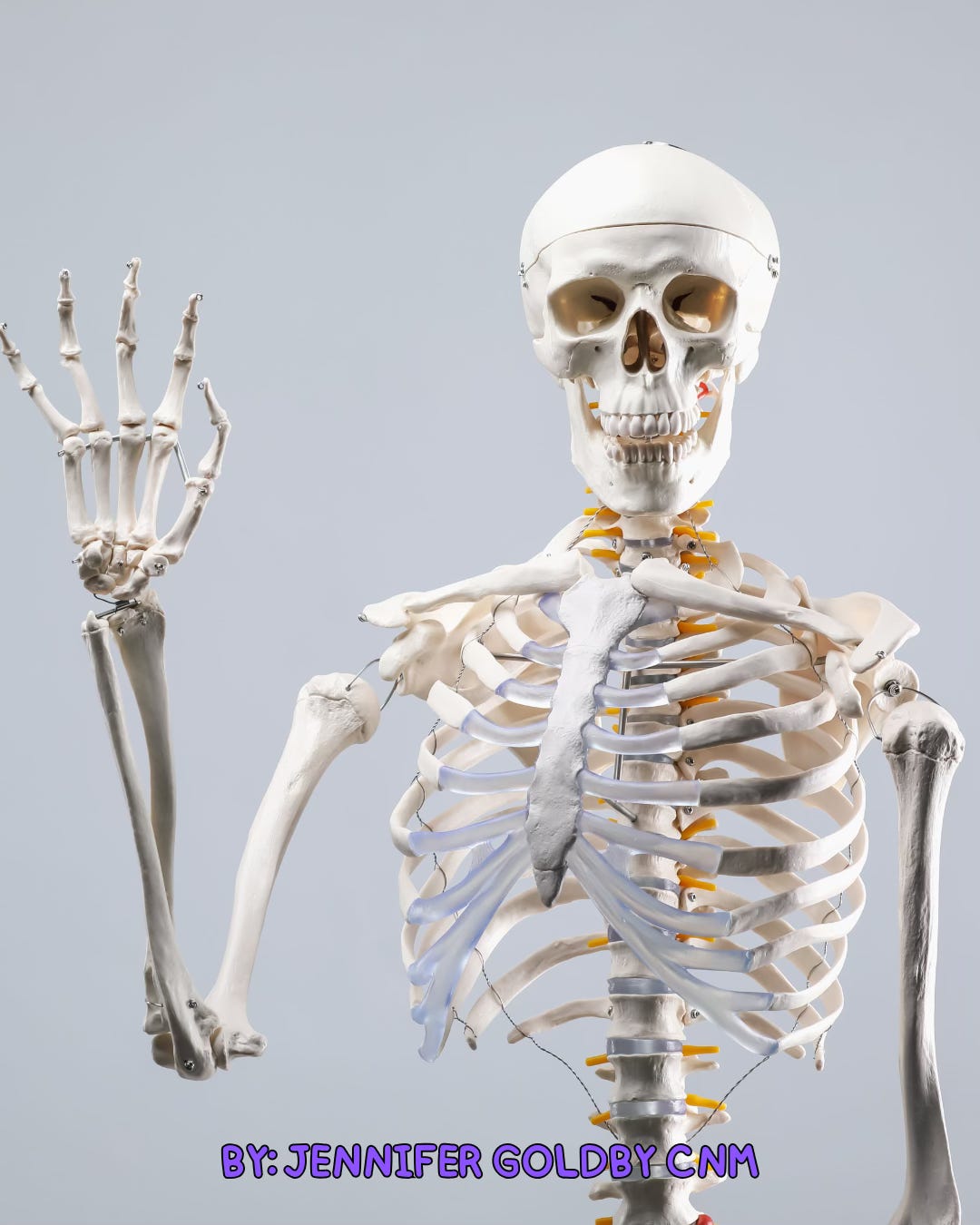
When most women hear the word osteoporosis, they picture an older woman, stooped and fragile, someone far removed from where they are now. The condition feels distant. Abstract. Something to think about eventually.
I understand why that is. But I want to offer you a different frame, because the biology doesn’t wait for eventually. The process that determines your fracture risk at 70 is already underway at 47. And the window in which you have the most leverage to change the outcome is right now, during the years of the menopause transition.
This is the conversation we should be having earlier. And mostly, we aren’t.
Your bone is alive
One of the things I want you to understand from the start is that bone isn’t inert. It isn’t static calcium sitting in a fixed structure. Bone is living tissue, constantly being broken down and rebuilt through a process called remodeling.
Two types of cells run this process. Osteoclasts are the demolition crew. They dissolve small sections of old or damaged bone. Osteoblasts are the builders. They move in afterward and lay down new bone to fill the spaces. In a healthy, hormonally supported system, these two activities stay roughly in balance.
Estrogen is the regulator. It keeps the osteoclasts from getting overzealous. It does this through several pathways, but the most important one involves a signaling molecule called RANKL. Estrogen promotes the production of a protein called osteoprotegerin, which essentially blocks RANKL from activating osteoclasts. When estrogen levels fall, that restraining signal disappears, and the demolition crew starts working faster than the builders can keep up.
That imbalance is the core of what happens to bone during perimenopause.
When bone loss accelerates
Bone loss doesn’t happen at a steady, gradual rate throughout life. There is a specific window of accelerated loss that is tied almost entirely to the hormonal changes of the menopause transition.
The SWAN study, one of the largest and most comprehensive long-term studies of women’s health across the menopause transition, tracked bone density in over 2,000 women for more than 20 years. What they found was striking in its specificity. Bone density was relatively stable during premenopause and early perimenopause. Then, beginning about one year before the final menstrual period, loss accelerated sharply. For approximately three years surrounding that final period, bone density declined at roughly 2% per year at the spine. In the hip, losses were closer to 1 to 1.5% per year. After that acute window, loss continued in the postmenopausal years, but more slowly.
To put that in concrete terms: over ten years following the final menstrual period, cumulative bone density decline averaged around 10%. And women who start that transition with lower baseline density, or who lose more rapidly, face substantially higher fracture risk down the road.
One additional detail from the research that I find important for clinical timing: it isn’t just low estrogen that triggers bone loss. Elevated FSH, the follicle-stimulating hormone that rises during perimenopause even before estrogen has dropped significantly, appears to independently accelerate bone resorption. This means bone loss can be underway before women or their providers expect it, often years before menopause is reached.
A note on fracture risk and ethnicity
Not all women face the same fracture risk, and this matters for clinical decision-making. Non-Hispanic white women and Native American women face the highest rates of low bone mass and osteoporotic fracture in the United States. Asian American women often have lower bone mineral density by measurement but fracture less frequently than white women, a finding related to differences in bone geometry and structure. Black women generally have higher bone density and lower fracture rates than white women, though this difference is not fully explained by body weight alone. These differences mean that population-level averages tell only part of the story. Your individual risk picture matters more than any single group statistic.
Why a fracture is not just a fracture
When I talk to patients about bone health, I sometimes sense that the stakes don’t quite land. Osteoporosis feels like a nuisance condition, something that causes stooped posture or a broken wrist that heals eventually. I want to be honest with you about how serious this can become.
Hip fractures are the outcome most associated with severe consequences. Approximately 18 to 33 percent of older adults who sustain a hip fracture die within the following year. Not from the fracture itself, typically, but from the cascade it initiates: immobility, pneumonia, cardiovascular events, surgical complications, a physiological unraveling that begins the moment someone goes down. An additional 50 percent of hip fracture survivors face significant functional decline and may be unable to perform basic daily tasks independently. About 20 percent transition to long-term care facilities.
Vertebral fractures are also serious. They often happen without a dramatic fall, sometimes without the person even knowing initially, and they cause chronic pain, height loss, and the characteristic spinal curve that most people associate with advanced osteoporosis. They also increase the risk of future fractures significantly.
The point I’m trying to make is that osteoporosis is not a cosmetic condition. It is a longevity condition. Bone health is directly connected to how long you live independently and how much control you have over your own life in the decades ahead.
What you can do right now
The research on intervention is genuinely encouraging if you’re in the perimenopause or early postmenopause years. That acceleration window is also the window in which prevention is most powerful. Here is what the evidence actually supports.
Mechanical loading through resistance training.
Bone responds to mechanical stress. When you load it, the cells that build bone get the signal to do their job. Resistance training, particularly exercises that load the spine and hips, is consistently shown to preserve and in some cases modestly improve bone density in postmenopausal women. The key is adequate intensity. The LIFTMOR trial, which studied postmenopausal women with osteopenia and osteoporosis, found that supervised high-intensity resistance and impact training twice weekly for eight months improved lumbar spine and femoral neck bone density meaningfully, and did so safely. The take-home is that gentle, low-resistance movement is unlikely to produce significant bone benefit. Your skeleton needs to be challenged. Combined programs incorporating both resistance training and higher-impact weight-bearing activity appear to produce greater results than either alone.
Jumping, running, dancing, stair climbing, and loaded carries all count as osteogenic exercise. Swimming and cycling, despite being excellent for cardiovascular fitness, provide essentially no bone benefit because they remove weight-bearing stress.
Hormone therapy.
The evidence here is among the most consistent in all of women’s health. The Women’s Health Initiative trial, which remains the largest randomized controlled trial of hormone therapy in postmenopausal women, demonstrated a 34 percent reduction in hip fracture incidence and a 24 percent reduction in all fractures in women taking estrogen plus progestogen compared to placebo. This was true regardless of baseline bone density, meaning even women who were not already at high fracture risk saw significant protection.
A meta-analysis of 28 studies covering over 33,000 participants confirmed these findings, showing reductions in hip fractures of about 28 percent, vertebral fractures of about 37 percent, and all fractures of about 26 percent with hormone therapy use.
Hormone therapy is also the only intervention that addresses the upstream hormonal cause of accelerated bone loss rather than just managing its downstream effects. While there are real conversations to have about individual risk and benefit, bone protection is a meaningful and well-documented benefit, not a secondary consideration.
On timing
The skeletal benefits of hormone therapy are most pronounced when started early in the menopause transition, when bone loss is accelerating most rapidly. Research suggests that even a few years of therapy during that critical window may have longer-lasting protective effects on fracture risk than the duration of treatment alone would predict. This is one reason why earlier conversations about the menopause transition matter for bone health, not just for symptom management.
Adequate calcium and vitamin D.
These are foundational but frequently insufficient as standalone interventions. Calcium is the primary mineral component of bone. Vitamin D is required for calcium absorption and for bone cell function. Most women going through menopause need around 1,000 to 1,200 mg of calcium daily, ideally from food sources first, and vitamin D levels should be checked rather than supplemented blindly. The target is a 25-hydroxyvitamin D level above 30 ng/mL for optimal bone support. Women who are deficient, which is common, benefit meaningfully from supplementation. Women who are not deficient don’t necessarily get additional bone benefit from further supplementation, and there is some controversy about high-dose calcium supplementation and cardiovascular risk. Food-first is generally the better strategy.
Know your baseline.
Current guidelines recommend bone density screening with a DEXA scan at age 65 for average-risk women, and earlier for women with specific risk factors including early menopause, low body weight, smoking history, family history of fracture, or chronic steroid use. What I often see in clinical practice is that this conversation gets delayed until after the critical prevention window has already started to close.
If you are in perimenopause, particularly if you have any of the risk factors above, a baseline bone density scan now gives you useful information. It tells you where you’re starting from, which shapes every subsequent decision about exercise intensity, hormone therapy timing, and monitoring intervals.
The 50 percent statistic
One in two postmenopausal women will experience an osteoporotic fracture during their lifetime. That number sits alongside one in eight for breast cancer, a condition that receives far more attention, screening resources, and cultural awareness. Bone health deserves the same sustained, proactive attention.
The frame I want to leave you with
Bone health in your 40s and 50s is not about vanity or aesthetics. It isn’t about avoiding a diagnosis. It’s about preserving your capacity to move through the world on your own terms for as long as possible.
The women who fracture a hip at 74 and never quite recover didn’t fail to take care of themselves. Many of them simply weren’t given the conversation early enough, the one that says: here is what is happening to your skeleton right now, here is the window in which it matters most, and here are the things that actually change the trajectory.
You’re having that conversation now. That matters.
Sources
Greendale GA, et al. Bone mineral density changes during the menopause transition in a multiethnic cohort of women. Journal of Clinical Endocrinology & Metabolism. 2008.
SWAN Fact Sheet: Bone Health over the Menopause Transition. Study of Women’s Health Across the Nation. 2023.
Hsu SH, Chen LR, Chen KH. Primary osteoporosis induced by androgen and estrogen deficiency: molecular and cellular perspective. International Journal of Molecular Sciences. 2024;25:12139.
Rossouw JE, et al. Risks and benefits of estrogen plus progestin in healthy postmenopausal women: principal results from the WHI randomized trial. JAMA. 2002;288(3):321-333.
Rozenberg S, et al. Menopausal hormone therapy for the management of osteoporosis. Best Practice & Research Clinical Endocrinology & Metabolism. 2021.
Zhu L, et al. Meta-analysis: menopausal hormone therapy reduces the risk of hip, vertebral, and all fractures. 2016.
Watson SL, et al. High-intensity resistance and impact training improves bone mineral density and physical function in postmenopausal women with osteopenia and osteoporosis: the LIFTMOR randomized controlled trial. Journal of Bone and Mineral Research. 2018.
Mohebbi R, et al. Exercise training and bone mineral density in postmenopausal women: updated systematic review and meta-analysis. Osteoporosis International. 2023;34:1145-1178.
Sing CW, et al. Global epidemiology of hip fractures: secular trends in incidence rate, post-fracture treatment, and all-cause mortality. Journal of Bone and Mineral Research. 2023.
Scicolone MA, et al. Mortality following hip fracture in older adults with and without coronary heart disease. American Journal of Medicine. 2023.
Karlamangla AS, et al. Bone health during the menopause transition and beyond. PMC. 2018.
Past articles:


 | A guest post by
|